2. Forces
In order to properly understand tides, it is necessary to start with the fundamentals and work up. In physics, you cannot get much more fundamental than forces. It may be that you already have an idea in your head of what forces are, and are tempted to skip ahead, but I encourage you to persevere. This section will start simple, but get tricky fast.
Force basics
What is a force?
A force is an effect that causes an object to accelerate. “Acceleration” is a change in speed, direction of movement, or both.
Imagine a brick floating motionless in space. If a force is applied to that brick, then it will accelerate for as long as that force is applied, in the direction that the force is applied.

Now imagine the brick is travelling to the right at a constant speed. There are no forces being applied to the brick, so it is not accelerating. It’s important to note that objects do not need to have forces acting on them for them to be moving. By contrast, objects that are accelerating must have forces acting on them.

That brick is now acted upon by a force pointing to the left. For the entire period that the force is acting on the brick, the brick is accelerating to the left. Often we think of acceleration as only happening in the direction of motion. Here, we have acceleration to the left while the brick is still moving to the right. Eventually, the acceleration causes the brick to start moving to the left.

Newton’s second law
We can write down an equation which describes how forces and objects interact:
This is known as Newton’s second law. It tells us that the force applied to an object is proportional to its acceleration; in other words, the bigger the force, the greater the acceleration. It also tells us that the mass of an object affects its acceleration. If the same force is applied to a car and a planet, then the car will accelerate much quicker than the planet.
Up until now, the arrows in the illustrations have all been the same length. From now on, you will see different lengths - the longer the arrow, the stronger the force.
Optional: Newton’s second law
Resultant force
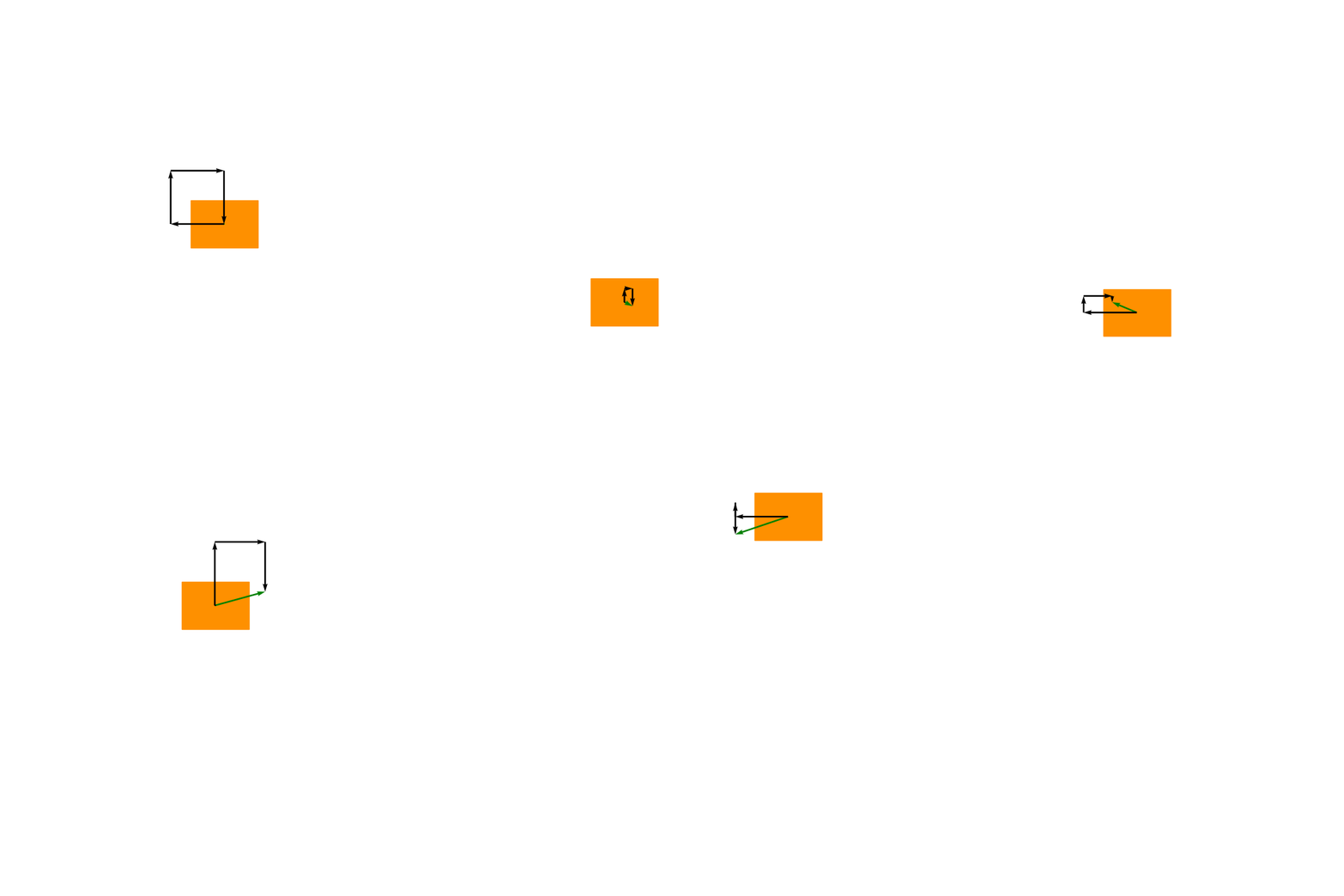
Most of the time, more than one force is acting on an object. These forces can act with or against each other. For example, initially the block below has four forces acting on it but is still not accelerating. This is because the forces are all the same size and point in opposite directions to each other, so their effects are balanced. After a few seconds the strengths of the forces change, and the block begins to accelerate and move in different directions.

When many forces are acting on an object, it can be hard to understand what the overall effect of those forces is. The best way to make this clearer is to find the sum of the forces - the resultant force. To add forces together, the individual force arrows can be drawn nose-to-tail. The resultant force can then be drawn as an arrow from the base of the first force to the tip of the last force.
The animation below shows exactly the same motion as the animation above. The only difference is that the forces have been drawn nose-to-tail in order to show the resultant force, the overall effect of the combined forces. This is an effective way of simplifying a physics problem; instead of considering four forces, we can instead think about a single equivalent force.