1. Why are tides so confusing?
If you Google “how do tides work?”, then you will come across a large number of explanations. NASA, Neil deGrasse Tyson, the BBC, and various surfing, fishing, and watersports websites have all had a go at it. In addition, forum sites like Reddit and Stack Overflow are filled with posts asking for help understanding tides, which ellicit varied and contradictory responses.
Most of these explanations are, at best, misleading, and at worst, factually wrong. But what is it that these explanations fail to explain properly?
The single-bulge model
Imagine a situation where the Earth is a perfect sphere and is very far away from anything else. This Earth is motionless, except that it spins once per day. Imagine that the planet is completely encased in water, which is held against the surface by the Earth’s gravity. The water does not spin with the Earth; it is completely stationary, while the Earth spins inside it. In this case, the depth of the water will be the same everywhere, and there will be no tides.
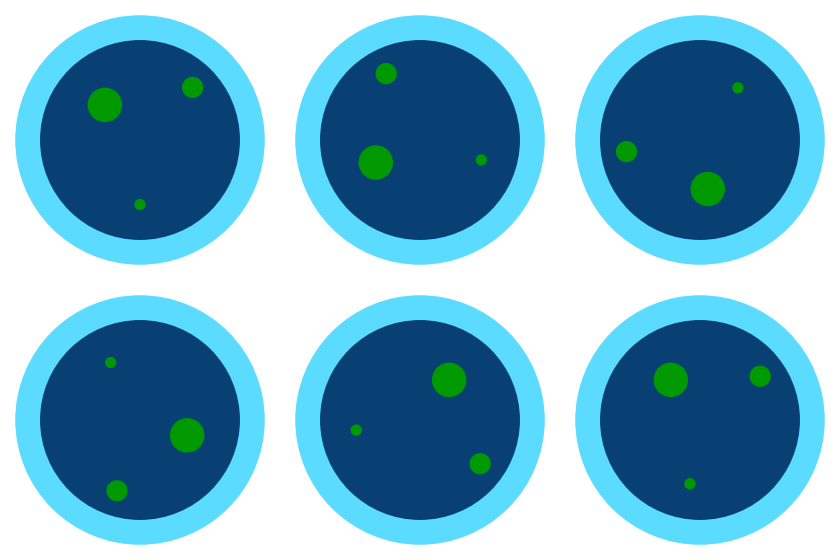
Now imagine that the Moon is slowly traveling around the Earth, completing about one orbit each month. Like the Earth, the Moon has a gravitational field which attracts the water. The water closest to the Moon is affected the most, and is pulled towards the Moon so that it forms a bulge. As each point on the Earth’s surface rotates through the bulge, the water level at that point rises and falls. This results in high and low tides.
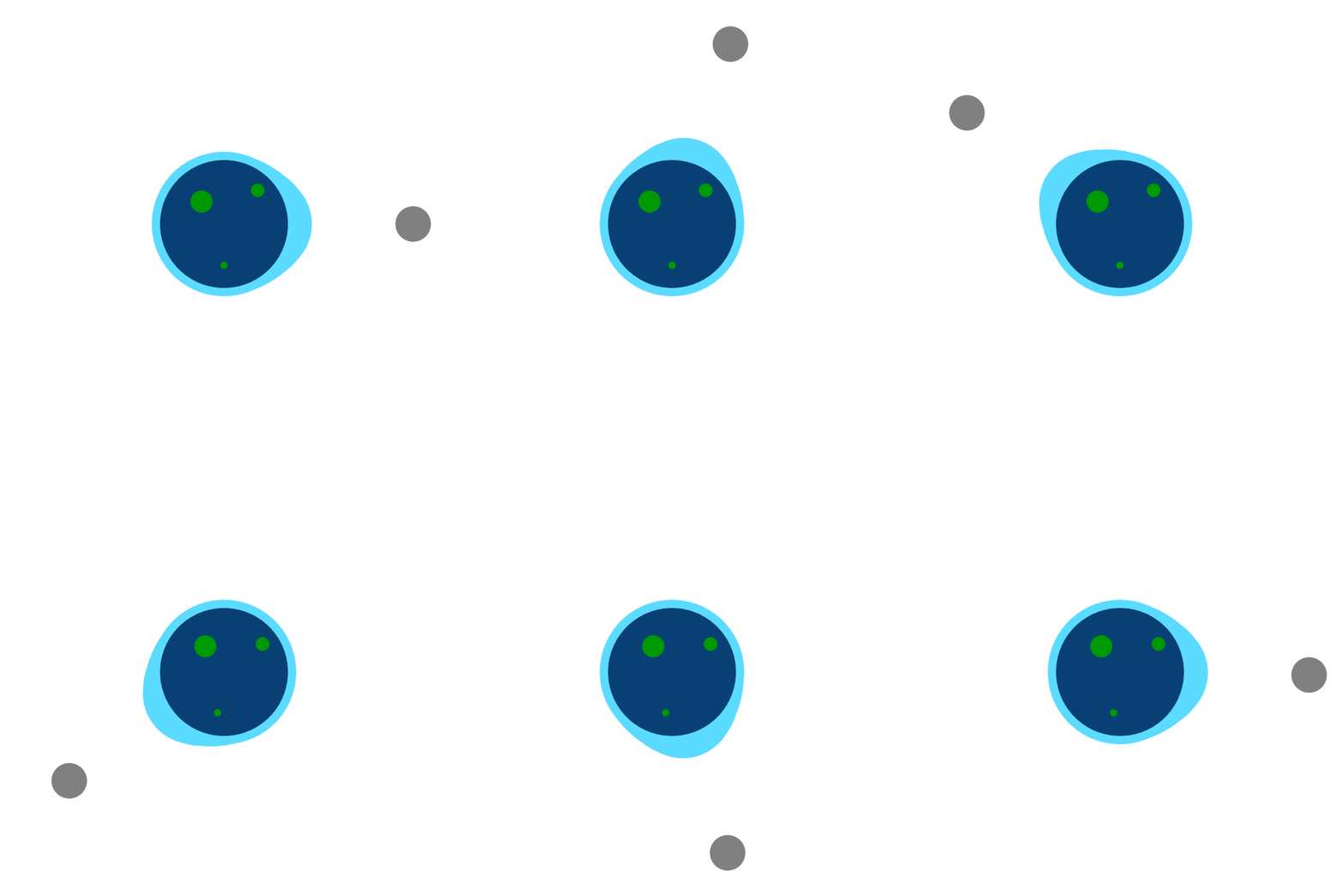
However, there is a big problem with the single-bulge model. The Earth spins once a day, while the bulge slowly progresses around the Earth in the same direction - this means that one high tide and one low tide occur in the span of around 25 hours. But in real life, two high tides and two low tides occur in this time. If you have spent time near the coast, then you probably will have noticed two high tides each day. Therefore, the single-bulge model does not make sense.
The double-bulge model
In order to fix the model, we must add second bulge opposite the first one. With two bulges, the Earth rotates through two tidal cycles in 25 hours, which matches real life!
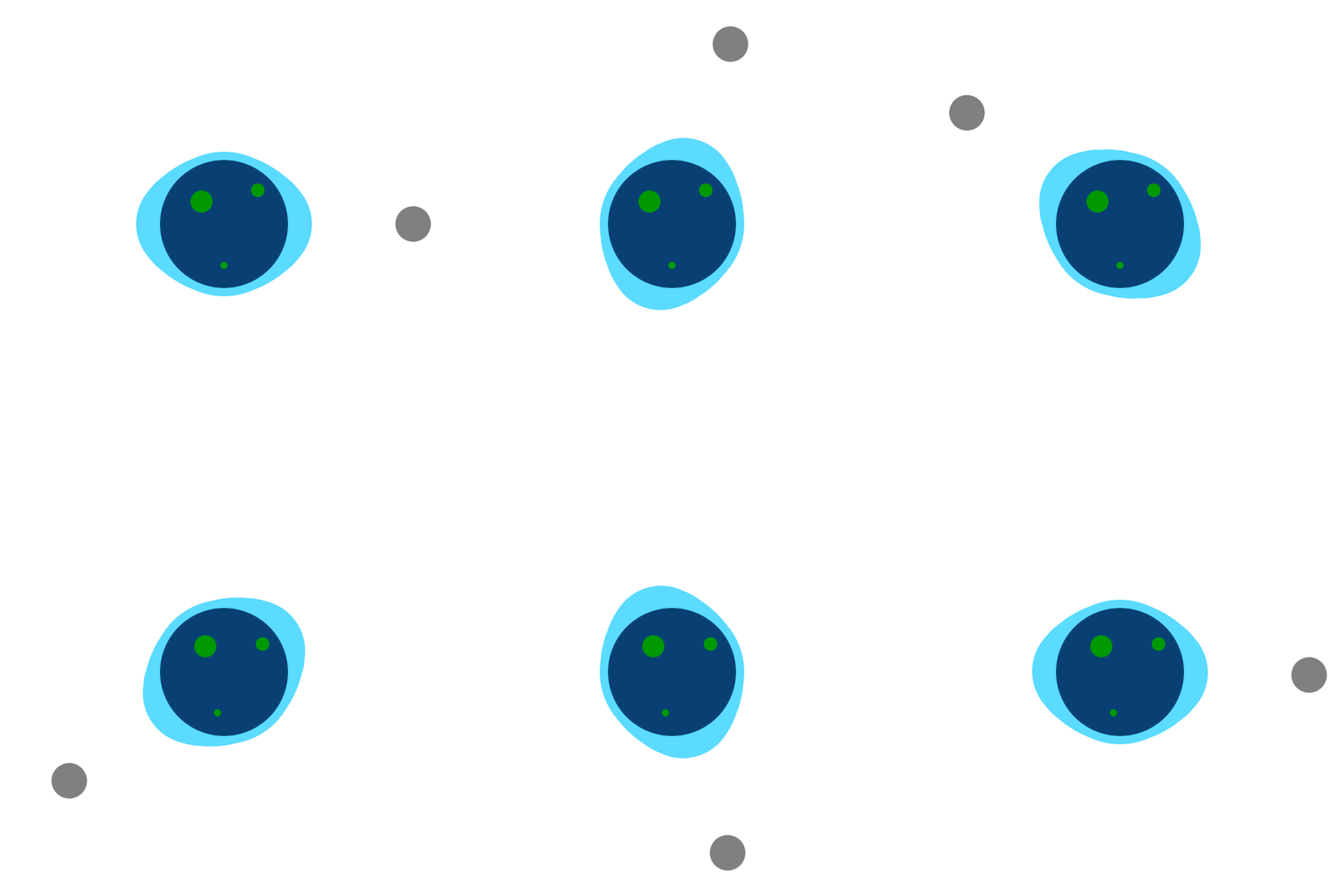
Almost any explanation of tides will include a prominent image of the double-bulge model. But what causes the second bulge? Unlike the first bulge, which is intuitively explained via the Moon’s gravity, the second bulge is not easily justified. The second bulge is, without doubt, the biggest source of confusion and disagreement surrounding online tidal discussions.
What causes the second bulge?
If the first bulge and the second bulge are compared, it would appear as though the second bulge is caused by an effect similar to the Moon’s gravity, but acting in the opposite direction. The range of explanations for this effect include:
- centrifugal or centripetal or inertial forces;
- water sloshing about, like in a bathtub;
- the sun.
These have varying values of correctness or relevance. Of this list, by far the most commonly mentioned phrase in tidal discourse is “centrifugal force”. You will find this phrase in many official-looking places, including textbooks and encyclopedias. And yet, if you only learn one thing from this site, it should be that centrifugal force is not the cause of any tidal effects. In fact, centrifugal force is not the “cause” of anything, as you will learn later. If you hear someone mentioning centrifugal force then you should challenge them to explain what it means; most people have no idea.
But the question still remains; what causes the second bulge? That is the question that the following sections will attempt to answer.
The aims of this site
In my experience, descriptions of tidal mechanics are either:
- overly simplified and absent of important details, leading to misconceptions;
- aimed at a professional scientific audience and so skip the fundamentals, making them impenetrable to most people.
This site aims to find a middle ground. It will assume minimal knowledge of physics and maths, but will go much further than the surface-level tidal explanations you will find on Google. The intended audience is anyone with a curiosity about tides, regardless of prior knowledge.
A common feature of poor science explanations is that they will lie to you in order to make things simpler. Here is my promise to you: I will not lie to you unless I have first told you that I am lying.
These pages will proceed as follows: first, you will learn about forces, gravity, and planets. Then, we will apply this knowledge to the double-bulge model, in order to explain where the second bulge comes from. Finally, the double-bulge model will be put into context with other tidal effects, in order to give a fuller picture of tides.
Please read on!